Parent Resources60-Second Calm-Down
Parenting & Emotional Wellness
60-Second Calm-Down Guide
When your child feels overwhelmed, one quiet minute can be a helpful place to start.
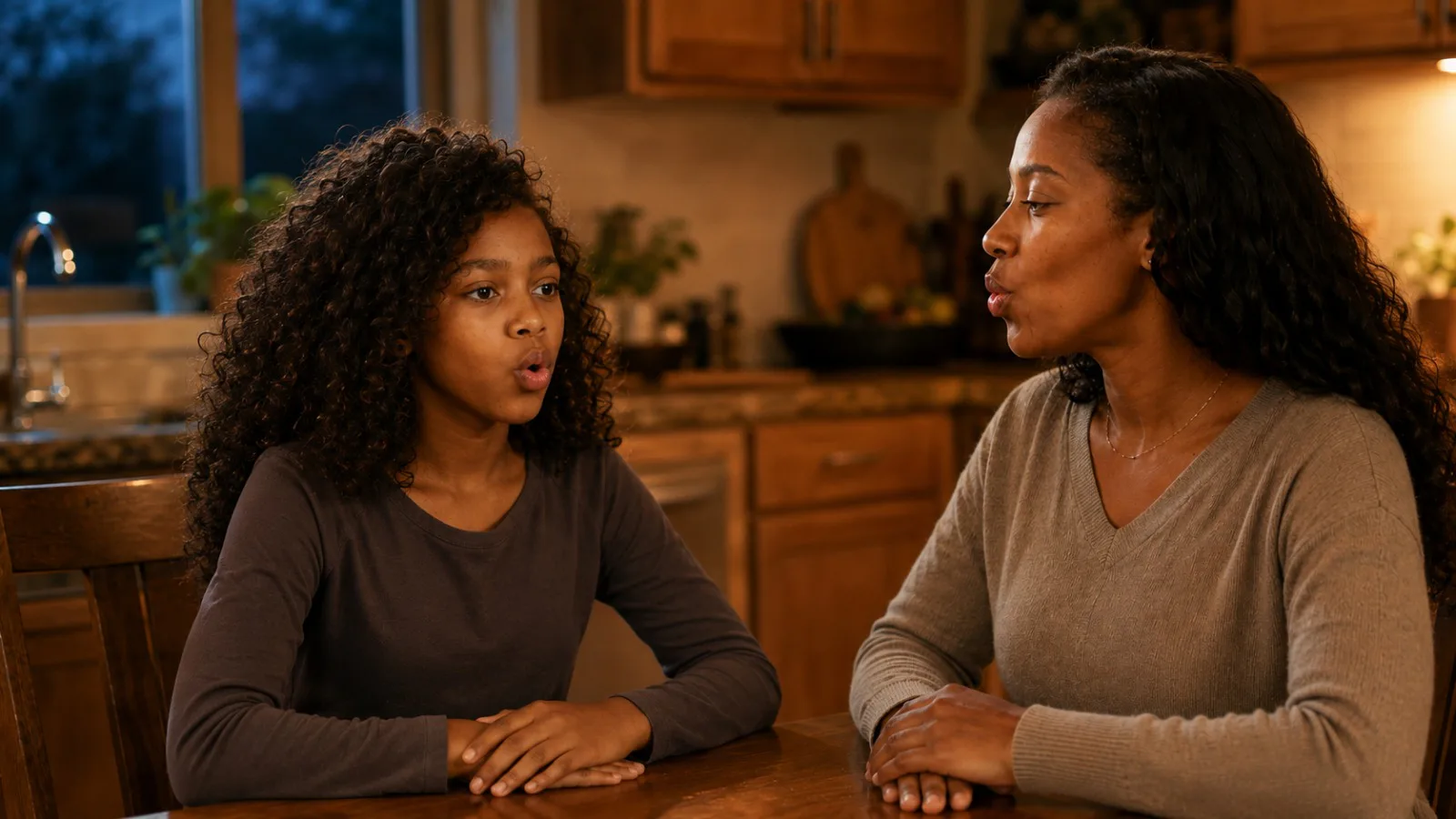
Your child is staring at a homework assignment and suddenly pushes the paper away.
“I can’t do this!”
Or maybe you’re running late for school, your child can’t find something they need, and frustration quickly turns into tears.
Perhaps it’s the night before a test and your child keeps saying:
“I’m going to fail.”
As a parent, your natural instinct may be to immediately fix the problem.
You explain the homework again. You tell your child there’s nothing to worry about. You remind them that they studied. You start offering solutions.
But sometimes, before children can work through the problem, they first need help settling enough to deal with it.
That’s where a simple 60-second calm-down can help.
It isn’t designed to make every difficult feeling disappear in one minute. Instead, it gives your child an opportunity to pause, focus on the present moment, and help their body begin to settle before deciding what to do next.
And the best part? It can be practiced almost anywhere.
Why Start With the Body?
When children feel overwhelmed, we often focus immediately on what they are thinking.
“You know you can do this.”
“There’s nothing to be afraid of.”
“Stop thinking negatively.”
Those conversations can be useful, but timing matters.
Imagine trying to reason with your child while they’re crying, breathing quickly, clenching their hands, or saying over and over:
“I can’t! I can’t! I can’t!”
That may not be the best moment for a long conversation.
Instead, start with something simple:
Help your child notice and settle their body.
Slow breathing and relaxation techniques are commonly used as coping strategies for children experiencing stress or anxiety.
The goal isn’t to tell your child, “Calm down.” It’s to give them something they can actually do.
The Exercise
The 60-Second Calm-Down
The exercise is simple:
- Breathe in slowly through your nose.
- Hold gently for a count of four.
- Breathe out slowly through your mouth.
- Repeat.
That’s it.
The exercise doesn’t require special equipment, a quiet room, an app, or a complicated set of instructions.
Your child can practice it while sitting at a desk, before homework, before a test, in the car before an activity, or at home when things begin to feel overwhelming.
The important part is not to rush.
Encourage a slow, comfortable breath rather than an unusually deep or forceful one. If holding the breath feels uncomfortable for your child, skip the hold and simply practice a comfortable, gentle inhale followed by a slower exhale.
What Can This Look Like at Home?
Imagine your ten-year-old is doing homework.
They’ve erased the same answer three times. Their shoulders are tense. Their voice gets louder. Finally, the pencil hits the table.
Child: “I don’t understand this! I can’t do it!”
Your first instinct may be: “Yes, you can. We just did one like this!”
Instead, try:
Parent: “I can see you’re getting frustrated. Before we work on the problem, let’s take one minute.”
Child: “But I have to finish this!”
Parent: “The homework will still be here. Let’s give your body a chance to settle first.”
Then guide them:
“Put your feet on the floor.”
“Let your shoulders relax.”
“Slowly breathe in through your nose.”
“Hold…2…3…4.”
“Now slowly breathe out through your mouth.”
Repeat.
At the end of the minute, don’t immediately ask, “Are you calm now?” That can make calmness feel like another task your child is expected to accomplish.
Instead ask:
“What do you notice now?”
Maybe your child says, “My shoulders aren’t as tight,” or “I still feel nervous, but not as much.” Or perhaps, “I don’t know.”
All of those responses are okay. The purpose is to help your child practice noticing what is happening inside them.
Don’t Wait Until the Meltdown
One of the most useful times to teach a calming exercise is actually when your child is already calm.
Think about learning to swim. We wouldn’t want a child’s first swimming lesson to happen after they unexpectedly fall into deep water. We teach and practice beforehand.
Calming skills work similarly.
Practice the 60-second exercise at an ordinary time: before bedtime, before starting homework, before leaving for school, or while sitting together on the sofa.
You might say:
“Let’s practice our one-minute breathing exercise.”

When children practice a skill repeatedly while calm, the steps can become more familiar and easier to remember when they are upset.
The goal is for your child eventually to recognize:
“I’m starting to feel overwhelmed. I know something I can try.”
That’s very different from waiting for an adult to say, “Calm down!”
Help Your Child Recognize Their Early Warning Signs
The 60-second exercise becomes even more useful when children learn to notice when they might need it.
Ask your child:
“How does your body tell you that you’re starting to feel overwhelmed?”
- Tight shoulders
- Clenched hands
- A funny feeling in their stomach
- Feeling hot
- Wanting to cry
- Breathing faster
- Difficulty sitting still
- Feeling like they can’t think clearly
Your child’s signals may be different.
The purpose isn’t to diagnose every sensation. It’s to help your child become more aware of what happens in their own body.
You might say, “When you notice your shoulders getting tight, that can be your reminder to pause.” Or, “When you notice yourself getting really frustrated with homework, let’s try our 60 seconds before we keep going.”
Now the breathing exercise isn’t something disconnected from everyday life. It becomes a tool.
A Key Insight
Calm First, Then Problem-Solve
Here’s an important distinction.
The 60-second calm-down isn’t meant to make the problem disappear.
After the breathing exercise, the math problem may still be difficult. The test is still tomorrow. The presentation still has to happen. The disagreement with a friend may still need to be addressed.
But your child may now be in a better position to ask:
“What can I do next?”
That’s the transition we’re looking for.
Not: Problem → instantly feel wonderful.
But:
The sequence
Problem → pause → notice → breathe → settle → decide what to do next.
That process teaches children that difficult feelings don’t always require an immediate reaction. Sometimes they can pause first.
What Parents Should Avoid
Try not to turn the calming exercise into a command or punishment.
If your child is upset, avoid saying:
“Go do your breathing until you can behave.”
That can cause the child to associate the exercise with being in trouble.
Instead, make it something supportive:
“Things feel pretty big right now. Want me to breathe with you?”
Also avoid demanding an immediate result: “You did the breathing. Why are you still upset?”
A child can use a calming strategy and still feel disappointed, nervous, angry, or frustrated. That’s okay.
The goal is not to teach children that uncomfortable emotions are bad. The goal is to help them learn that they have tools they can use while experiencing those emotions.
What Happens After the 60 Seconds?
This is where the exercise becomes more powerful.
After the breathing, help your child become curious about what’s happening.
“How do you feel right now?”
“What are you thinking about?”
“What would help you feel a little better?”
“What’s one thing you can do next?”
Maybe the answer is: “Try the first math problem again.” “Ask my teacher for help tomorrow.” “Practice the first part of my presentation.” “Tell you what happened at school.” Or “Take a short break and come back.”
The breathing created the pause. Now your child can begin learning what to do with that pause.
When a Calming Exercise May Not Be Enough
A 60-second breathing exercise is a coping tool, not a treatment for every emotional or behavioral difficulty.
If your child’s worry, fear, physical complaints, avoidance, sleep problems, or distress are persistent or are interfering with school, friendships, family life, or normal activities, consider discussing your concerns with your child’s pediatrician or a qualified mental-health professional.
Likewise, don’t assume recurring physical symptoms are simply caused by stress. Persistent, severe, new, or concerning physical symptoms should receive appropriate medical attention.
A calming exercise can be a useful skill, but it should not replace individualized professional evaluation or treatment when those are needed.
Go Deeper
Teach Your Child the 7 Steps
Learning how to calm the body is an important beginning.
But children can also learn to recognize where their attention is, what they’re feeling, what they’re thinking, how they want to feel, and what they can do next.
That’s what the 7 Steps Away From Anxiety & Stress Training is designed to help children practice.
The goal isn’t for your child to never experience stress or anxiety. It’s to help them develop practical tools they can use when those feelings appear.
Frequently Asked Questions
Will this exercise make my child calm in exactly 60 seconds?
Not necessarily. Think of 60 seconds as a simple starting point rather than a guarantee. Your child may feel noticeably different, slightly more settled, or still upset. The value is in learning to pause and practice a calming response.
What if my child doesn’t want to do the exercise?
Avoid turning it into a battle. You can model it yourself: “I’m going to take a few slow breaths because I notice I’m getting frustrated too.” Children can learn a great deal by watching adults use healthy coping strategies.
Should my child hold their breath for four seconds?
Only if it feels comfortable. The exercise should feel gentle, not forced. If the breath hold is uncomfortable, your child can simply breathe in comfortably and breathe out slowly.
When should we practice?
Don’t save it only for stressful situations. Practice during calm moments so your child becomes familiar with the steps.
What’s the most important thing for my child to remember?
They don’t have to solve everything the moment they feel overwhelmed.
Pause. Breathe. Notice what you’re feeling. Then decide what to do next.
Sixty seconds won’t make every difficult situation disappear. But it can give your child something valuable in the middle of one: a moment to pause—and a tool they know how to use.